
Clarify which air supply is insufficient
A complaint of stuffiness does not yet define the technical task. A system may move air within a building while supplying insufficient outdoor air, or provide the overall flow but distribute it unevenly between rooms. Supply, extract, recirculation and transfer air are therefore considered separately. Their values cannot replace one another when compared with the design.
The specialist establishes the room's purpose, design occupancy, serving unit and intended operating modes. For a room with variable occupancy, control operation at different loads is important. If documents specify an air change rate, the volume used and the airflow to which the calculation relates are checked. A universal requirement for every office, warehouse or kitchen is inapplicable here: the criterion is selected for the particular object and question.
Trace the airflow route to the room
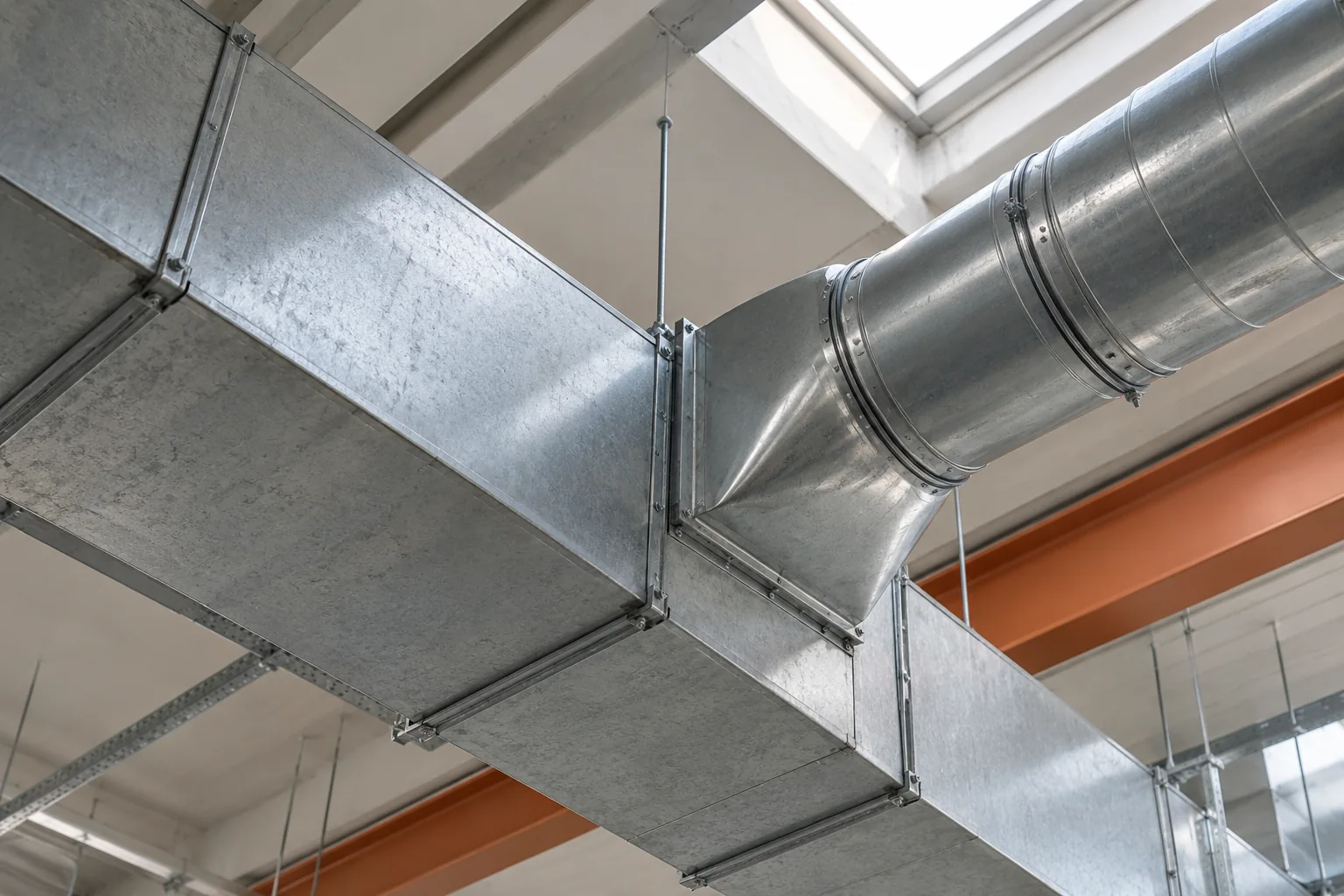
The accessible route from air intake and unit to terminal devices is examined. Filters, dampers, branches, flexible connections, regulating devices and return-air points are marked on the diagram. Actual connections are compared with the design configuration: a room may have been reconfigured or a grille moved while the serving branch remained unchanged.
Inspection helps select locations for further measurements. A dirty filter, closed damper or deformed section is treated as a circumstance to be checked. The appearance of a defect alone does not establish the magnitude of its effect on flow. Inaccessible sections are identified separately; the condition of a concealed duct is not reconstructed by guesswork. If intervention is found, its position relative to rooms with complaints is recorded, separating observation from an assumed cause.
Measure airflow with regard to its velocity profile
A single velocity at the centre of a grille is not the flow through the entire device. Measurements in a duct require a suitable cross-section, defined point positions and data on velocity distribution. The internal cross-sectional area and the processing method prescribed by the method are then used. A bend, branch or fan near the measurement point can distort the profile and limit result reliability.
A flow hood or another suitable method may be used at terminal devices. The instrument and terminal characteristics, specified corrections and the measuring device's own effect on flow are considered. The record needs point identification, original readings and a calculation that allows the result to be checked. Pressure and unit operating data add context, but a fan's rated capacity does not by itself confirm actual supply to a room.
Link readings to system operating conditions
Alongside flow rates, record unit settings, control device positions, operation of neighbouring extract systems and the state of supply terminals. For automatic controls, actual commands and feedback matter: ‘auto’ on a panel does not describe what task the controller is performing at that moment. Measurement times are linked to control logs where available.
Open windows, doors and outdoor conditions can substantially change the air balance; they are particularly important for natural ventilation. Comparison of different modes is planned as a separate part of the examination, retaining clear comparison conditions. Switching is coordinated with the person responsible for operation. If settings were changed before the initial state was recorded, later readings describe the modified system and do not prove what airflow existed earlier.
Distinguish insufficient flow from its cause
Results are compared at successive levels: unit, branch, terminal and room. This distinguishes an overall supply deficit from a distribution problem. A difference between the main duct measurement and the sum of grille flows requires a check of conditions and uncertainty; it cannot be treated as proven leakage without further justification. The conclusion must show which explanations are supported and which remain possible.
Carbon dioxide logging can supplement an examination when occupancy, outdoor background, sensor position and changes over time are known. A single value cannot reliably establish air exchange or assess every air pollutant. A useful outcome is a diagram showing flow rates and measurement conditions, a list of established deviations and the checks needed to select a justified correction.